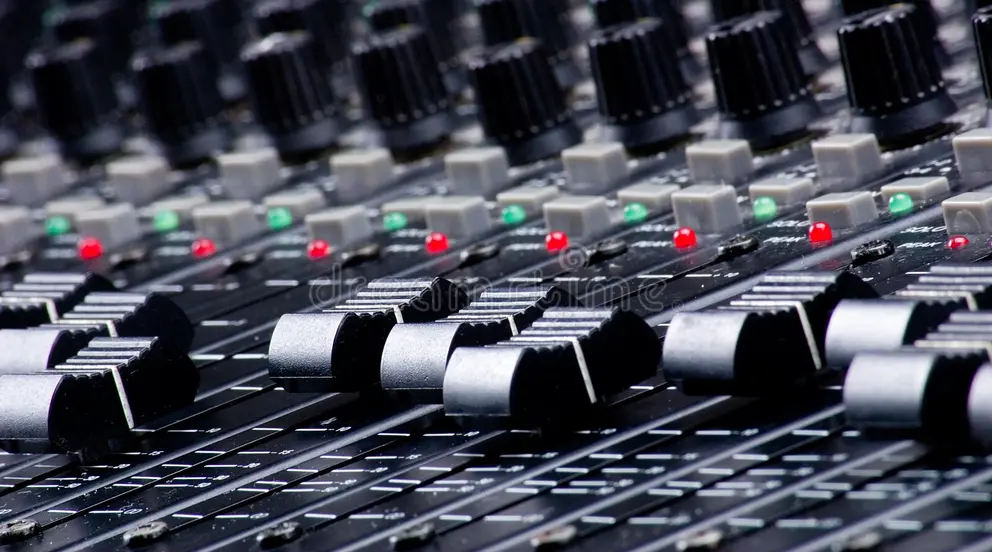
1. Gain Staging is Everything
Before you touch a single fader or EQ knob, get your gain structure right.
- Have the musicians play at their actual performance volume (they always play louder once the crowd arrives).
- Set your preamp gain so the hottest peaks sit safely in the green/yellow zone, well away from clipping.
- Proper gain staging gives you clean audio, a low noise floor, and ensures your compressors and effects behave predictably.
2. Protect Your Headroom (The “Subtract Before You Add” Rule)
If a instrument or vocal isn’t cutting through the mix, your first instinct shouldn’t be to push its fader up or boost its EQ frequencies.
- Use High-Pass Filters (HPFs): Clear out the low-end mud. Engage the HPF on vocals, guitars, cymbals, and keys to roll off everything below $80\text{ Hz} – 100\text{ Hz}$. This frees up massive amounts of headroom for your kick drum and bass.
- Carve, Don’t Boost: If a vocal sounds muddy, cut some of the low-mids ($200\text{ Hz} – 400\text{ Hz}$) instead of boosting the highs.
3. Ring Out the Monitors First
Feedback is the ultimate enemy of a live sound engineer. Before the band even starts a full soundcheck, ring out the stage wedges.
- Push a vocal mic until it just starts to ring.
- Use a parametric or graphic EQ to notch out that specific problem frequency.
- Repeat the process for the next couple of frequencies that pop up. This gives the band a much louder, clearer monitor mix before feedback occurs.
4. Manage Stage Volume
A great Front of House (FOH) mix is impossible if the stage volume is deafening.
- Guitar amplifiers are notoriously directional and often blast right past the guitarist’s ankles straight into the vocal mics. Ask players to angle their cabinets upward or slightly off-stage.
- Encourage the use of in-ear monitors (IEMs) or keep the stage wedges as quiet as the band is comfortable with to prevent bleed into your main mix.
5. Walk the Room
What sounds incredible at the mixing console might sound completely different in the front row or dead in the back corners.
- During soundcheck, leave the board and walk around the entire venue.
- Pay attention to the coverage of your PA system. If the highs are piercing near the stage but dull in the back, you may need to adjust the physical tilt of your speakers or compensate slightly in your master EQ.
Leave a Reply